Hemidesmus indicus


Family: Asclepiadoideae 
The stem and branches of H. indicus twine anticlockwise, and are profusely laticiferous, elongate, narrow, teret and wiry of deep purple or purplish brown colour with the surface slightly ridged at the nodes. Roots are woody, slender and aromatic. Roots smell similar to camphor, hence the plant is also known as Kapoori. 
The extracts from the root are used as a coolant and a blood-purifier and also used in many other forms, especially as refreshing syrup with sugar and a dash of lemon (Sharbat), and served at most small refreshment shops in South India.

Argemone mexicana


Family: Papaveraceae
An extremely hardy pioneer plant, it is tolerant of drought and poor soil, often being the only cover on new road cuttings or verges. It has bright yellow latex, and though poisonous to grazing animals, is rarely eaten.


Seeds contain 22–36% of a pale yellow non-edible oil, called argemone oil or katkar oil, which contains the toxic alkaloids sanguinarine and dihydrosanguinarine. The last major outbreak in India occurred in 1998. 1% adulteration of mustard oil by argemone oil has been shown to cause clinical disease. in India, Argemone oil is mixed with sunflower oil and sesame oil to increase the quantity, but this adulteration causes health disorders and renowned brands display "no argemone oil" to qualify purity. Argemone mexicana may be a suitable first-aid treatment in rural areas when access to other better antimalarials is delayed.

Celastrus paniculatus


Family: Celastraceae
Local Name: Pengu
Deciduous vine with stems up to 10 cm (3.9 in) in diameter and 6 m (20 ft) long with rough, pale brown exfoliating bark covered densely with small, elongated lenticles. The leaves are simple, broad, and oval, obovate or elliptic in shape, with toothed margins.
The plant, which is widely known as the “intellect tree,” is used to both sharpen mental focus and relax the nerves. elastrus paniculatus seeds can also reduce cholesterol.

Costus speciosus


Family: Costaceae
Local: Kaukauka
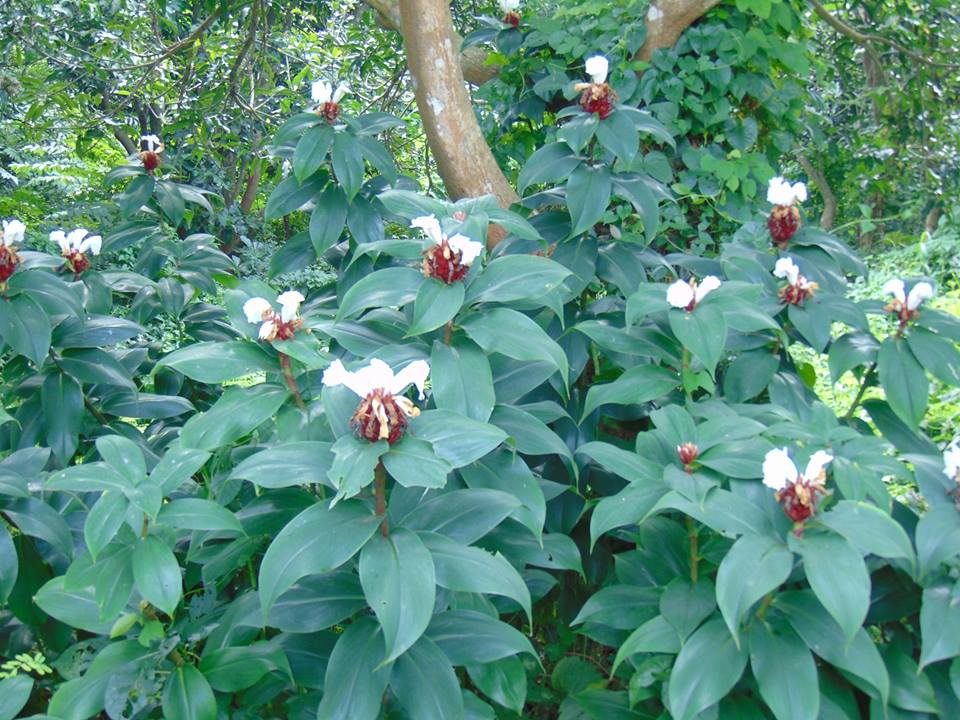
Cheilocostus speciosus differs from the common ginger by having only one row of spirally arranged leaves. The species reproduces vegetatively by rhizome, and birds disperse the seeds when they feed on the fruits. The habitat where this species is found is roadside ditches and low-lying areas in the forest. The flowering season starts after the rainy season, from October to December.The plant has many historical uses in Ayurveda, where the rhizome has been used to treat fever, rash, asthma, bronchitis, and intestinal worms. It is mentioned in the Kama Sutra as an ingredient in a cosmetic to be used on the eyelashes to increase sexual attractiveness.

Periyar Tiger Reserve to use cameras to monitor tigers: An initiative-Padma Mahanti

Periyar Tiger Reserve to use cameras to monitor tigers

Taallakkadav (Kerala) (PTI): The Periyar Tiger Reserve (PTR) has decided to monitor tigers by cameras to identify animals, their home range and their stripe patterns.

The Scientific Monitoring of Tigers exercise is likely to commence at the reserve that houses about 35 tigers, in January.
 
“About 40 cameras in pairs of two each would be set up in four sq km grid to ‘trap’ the animals. The entire 777 square km of the reserve would be covered within four to five months time,” PTR Deputy Director, Padma Mahanti, told PTI.
 
Seventeen tribals and two local youths have been trained to operate the cameras and help the forest officials in the exercise, she said.
 
“It would help in identifying the individual tigers, their home range and their stripe patterns. The cameras would be shifted every 15 days. Tribals and locals along with forest officials would monitor the activities of the animals after the traps are set,” Mahanti added.
 
The reports compiled would be submitted to the field directorate which in turn would send it to the National Tiger Conservation Directorate at New Delhi for records.
 
Presently monitoring of tigers is done by collecting its pug marks with the help of plaster casts.
 
“Scratches of claw marks on trees, tiger calls, direct sighting and kills made by the animal are also recorded. All the information are passed through wireless network to the central pooling system of the PTR,” Mahanti said.
 
News Update Service
Monday, December 24, 2007 : 1140 Hrs
 
http://www.hindu.com/thehindu/holnus/004200712241140.htm
 

Periyar Tiger Reserve to monitor tigers using camera trap for the First Time-2007- Padma Mahanti

Padma Mahanti

Source : http://www.livemint.com/Home-Page/wrPIc9WCwqVwMHDDtPGXaO/Periyar-Tiger-Reserve-to-use-cameras-to-monitor-tigers.html) 
Updated: Mon, Dec 24 2007. 01 53 PM IST
PTI
Kerala: The Periyar Tiger Reserve (PTR) has decided to monitor tigers by cameras to identify animals, their home range and their stripe patterns.
The Scientific Monitoring of Tigers exercise is likely to commence at the reserve that houses about 35 tigers, in January.
“About 40 cameras in pairs of two each would be set up in four sq km grid to ‘trap´ the animals. The entire 777 square km of the reserve would be covered within four to five months time,” PTR Deputy Director, Padma Mahanti, told PTI.
17 tribals and two local youths have been trained to operate the cameras and help the forest officials in the exercise, she said.
“It would help in identifying individual tigers, their home range and stripe patterns. The cameras would be shifted every 15 days. Tribals and locals along with forest officials would monitor the activities of the animals after the traps are set,” Mahanti added.
The reports compiled would be submitted to the field directorate which in turn would be sent to the National Tiger Conservation Directorate at New Delhi for records.
Presently monitoring of tigers is done by collecting its pug marks with the help of plaster casts.
“Scratches of claw marks on trees, tiger calls, direct sighting and kills made by the animal are also recorded. All the information are passed through wireless network to the central pooling system of the PTR,” Mahanti said.
Comment E-mail Print  Share 
First Published: Mon, Dec 24 2007. 01 53 PM IST

Thalkudi (Centella asiatica L.): A Brain Tonic among the Rural and Tribal Communities of Odisha, India


Sanjeet Kumar1*, Gitishree Das2 and Jayanta Kumar Patra3*
1School of Life Sciences, Ravenshaw University, Cuttack- 753003, Odisha, India
2School of Biotechnology, Yeungnam University, Gyeongbuk 38541, Republic of Korea
3Research Institute of Biotechnology & Medical Converged Science, Dongguk University, Gyeonggi-do 10326, Republic of Korea
*Corresponding author: Sanjeet Kumar, School of Life Sciences, Ravenshaw University, Cuttack- 753003, Odisha, India, E-mail:sanjeet.biotech@gmail.com
Jayanta Kumar Patra, Research Institute of Biotechnology & Medical Converged Science, Dongguk University, Gyeonggi-do 10326, Republic of Korea, Tel: 82-31-961-5625; Fax: 82-31-961-5621; E-mail: jkpatra@dongguk.edu

Citation: Kumar S, Das G, Patra JK (2016) Thalkudi (Centella asiatica L.): A Brain Tonic among the Rural and Tribal Communities of Odisha, India. J Alt Med Res 2(1): 112.

 Abstract

Odisha is rich in biodiversity of medicinal flora. “Thalkudi” (Centella aciatica L.) is a common important traditional herb have been utilizing as brain tonic and purpose of memory enhancer among the tribal group and rural community of different rural and forest divisions of the state. The present study deals with the documentation from the field survey for highlighting the ethnomedicinal properties and pharmacological activity of Thalkudi (Centella asiatica L.).

 Keywords: Thalkudi; Tribal Community; Ethnomedicinal Value; Pharmacological Activity

Kerang: A cultural heritage of Deomali hills

The Gadaba and Bonda tribal communities of the Deomali hills possess an age-old tradition of weaving distinctive textiles using fibres deriv...