Medicinal Plants of India-I

Sanjeet

Abelmoschus crinitus WALL.
Abelmoschus esculentus (L.) MOENCH
Abelmoschus ficulneus (L.) WIGHT & ARN.
Abelmoschus manihot (L.) MEDIK.
Abelmoschus moschatus MEDIK.
Abies densa W. Griff. ex.Parker
Abies pindrow ROYLE
Abies spectabilis (D.DON) SPACH
Abrus fruticulosus WALL. EX WIGHT & ARN.
Abrus precatorius L.
Abutilon hirtum (LAM.) SWEET
Abutilon indicum (L.) SWEET
Abutilon indicum (L.) SWEET Subsp. guineense (SCHUMACH.) BORSSUM
Abutilon pannosum (G. FORST.) SCHLTDL.
Abutilon persicum (BURM.F.) MERR.
Abutilon theophrasti MEDIK.
Acacia arabica WILLD.
Acacia catechu (L.F.) WILLD.
Acacia catechu (L.F.) WILLD. Var. sundra (DC.) PRAIN
Acacia chundra (ROXB. EX ROTTLER) WILLD.
Acacia dealbata LINK.
Acacia decurrens WILLD.
Acacia eburnea (L.F.) WILLD.
Acacia farnesiana (L.) WILLD.
Acacia ferruginea DC.
Acacia jacquemontii BENTH.
Acacia leucophloea (ROXB.) WILLD.
Acacia melonoxylon R.BR.
Acacia modesta WALL.
Acacia nilotica (L.) WILLD. EX DEL. Subsp. indica (BENTH.) BRENAN
Acacia pennata (L.) WILLD.
Acacia planifrons WIGHT & ARN.
Acacia polyacantha WILLD. Subsp. polycantha BRENAN
Acacia pseudo-eburnea DRUM
Acacia pycnantha BENTH.
Acacia senegal WILLD.
Acacia sinuata (LOUR.) MERR.
Acacia tomentosa WILLD.
Acacia torta (ROXB) CRAIB
Acalypha alnifolia KLEIN EX WILLD.
Acalypha betulina RETZ.
Acalypha ciliata FORSK.
Acalypha fruticosa FORSSK.
Acalypha hispida BURM.F.
Acalypha indica L.
Acalypha paniculata MIQ.
Acalypha racemosa WALL. EX BAILL.
Acampe papillosa (LINDL.) LINDL.
Acampe praemorsa (ROXB.) BLATT. & MCCANN
Acanthopanax trifoliatus (LINN.) VOSS.
Acanthospermum hispidum DC.
Acanthus ilicifolius L.
Acer caesium WALL.
Acer cappadocicum GLEDITSCH
Acer laevigatum WALL.
Acer mono MAXIM.
Acer oblongum WALL. EX DC.
Acer pentapomicum STEWART.EX BRAND
Acer pictum THUNB.
Achillea millefolium LEDEB.
Achillea santolina L.
Achyranthes aspera L.
Achyranthes aspera L. Var. rubro-fusca HOOK. F.
Achyranthes bidentata BLUME
Achyranthes porphyristachya WALL. EX MOQ.
Aconitum atrox (BRUHL) MUK.
Aconitum bisma (HAM.) RAPAICS
Aconitum chasmanthum STAPF EX HOLMES
Aconitum deinorrhizum STAPF
Aconitum elwesii STAPF
Aconitum falconeri STAPF
Aconitum ferox WALL. EX SERINGE
Aconitum heterophyllum WALL. EX ROYLE
Aconitum kashmiricum STAPF EX COVENTRY
Aconitum laciniatum (BRUEHL) STAPF
Aconitum laeve ROYLE
Aconitum lethale GRIFF.
Aconitum luridum HOOK.
Aconitum moschatum (BRUEHL) STAPF
Aconitum napellus L.
Aconitum rotundifolium KAR. & KIR.
Aconitum soonoricum STAPF
Aconitum spicatum (BRUHL) STAPF
Aconitum violaceum JACQ. EX STAPF
Aconogonum rumicifolium (ROYLE EX BAB.)HARA
Aconogonum tortuosum (D.DON)HARA
Acorus calamus L.
Acorus gramineus AIT.
Acrocarpus fraxinifolius WIGHT & ARNOLAL
Acrocephalus hispidus (L.) NICOLS. & SIVADASAN
Acronychia pedunculata (L.) MIQ.
Acroptilon repens (L.) DC.
Acrostichum aureum L.
Acrotrema arnottianum WIGHT
Actaea racemosa -
Actaea spicata L.
Actiniopteris radiata (SW.) LINK
Actinodaphne angustifolia NEES
Actinodaphne dichotoma FLORSK.
Actinodaphne obovata BLUME

HIGH PERFORMANCE LIQUID CHROMATOGRAPHY

Sanjeet
High performance liquid chromatography is highly improved column chromatography used in separation, purification and characterization of non-volatile compounds.
Ø It has three important parts: Sampler, Pumps and Detector
Major modes of separation
Ø Reversed-phase chromatography
Ø Normal-phase and adsorption chromatography.
Ø Ion Exchange Chromatography
Ø Size Exclusion Chromatography
Typical non-volatile compounds that can be analysed in HPLC are
Ø Pharmaceuticals
Ø Proteins
Ø Organic chemicals
Ø Heavy hydrocarbons
Ø Natural product
Main ways to interpret a Chromatography
Ø Peak height (Purification)
Ø Peak area (Quantitative assessment)
Applications
1.    HPLC is optimum for the separation of chemical and biological compounds that are non-volatile, such as:
a)    Salts
b)   Pharmaceuticals – Aspirin
c)    Proteins
d)   Organic chemicals - Polystyrene
e)    Natural hydrocarbons- asphalt 
f)     Thermally unstable- TNT
2.    Identification and quantification of the sample components using the determination of peak height and peak area.
3.    Determination of trace pharmaceutical compounds using very sensitive detectors.
Factors
1.    Reproducibility
Ø Retention in HPLC is temperature-dependent.
Ø If temperature varies, then it is difficult to assign “peaks” to specific compounds in the chromatogram.
2.    Solubility
Ø Certain chemical compounds may have low solubility in the HPLC mobile phase.
3.    Stability
Ø The temperature needs to be much lower down to 4 °C.
Columns
1)   Usually stainless steel.
2)   Length 10-30 cm
3)   Packing are 3, 5 or 10 µm particle size
4)   Normally packed under 6000 psi
Detectors
1)   Filter instrument
2)   Variable wavelength
3)   Diode array detector

Nuclear Magnetic Resonance: An instrument for characterization of new compounds

Sanjeet Kumar
Ravenshaw university
sanjeet.biotech@gmail.com
 

NMR is one of the principal techniques used to obtain physical, chemical, electronic and structural information about molecules due to either the chemical shift, zeemen effect, or the knight shift, or a combination of both, on the resonant frequencies of the nuclei present in the sample. It is a powerful technique that can provide de
Ø Tailed information on the topology, dynamics and three-dimensional structure of molecular in solution and the solid.
Ø NMR was first described and measured in molecular beams by Isidor Rabi in 1938 and was awarded the Nobel Prize in physics.
Ø There are following types of NMR spectroscopy
o   Continuous wave (CW) spectroscopy
o   Fourier transform spectroscopy
o   Multi-dimensional NMR spectroscopy
o   Solid-State NMR spectroscopy

Hardware of NMR
1.    Magnet
2.    Field Lock
3.    Shim Coils
4.    Sample probe
5.    RF coils
6.    Gradient Coils
7.    Quadranture Detector
8.    Digital Filtering
Carbon-13 NMR
Many of the molecules studied by NMR contain carbon. Unfortunately, the C-12 nucleus does not have a nuclear spin, but the carbon-13 nucleus does due to the presence of an unpaired neutrons. It is less sensitive than Hydrogen NMR spectroscopy.

Applications
Important applications of NMR are:
1.    Molecular structure and conformational changes of molecules can be determined by NMR.
2.    The technique along diffraction data is used in molecular modelling.
3.    High resolution protein structures have been elucidated by NMR.
4.    The technique has been applied to study enzymes kinetics.
5.    Structural studies on both DNA and RNA.
6.    Interactions between proteins and lipid bilayers in membranes have been observed to predict their possible biological functions.
7.    Intracellular and extracellular inorganic phosphate concentrations may be measured in living cells and tissues.


Genomic analysis using microarray

Sanjeet

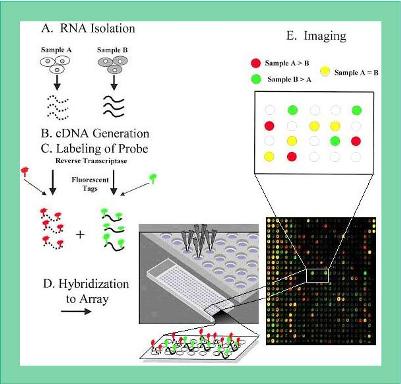
A microarray is a tool for analyzing gene expression that consists of a small membrane or glass slide containing samples of many genes arranged in a regular pattern. Microarray technology has empowered the scientific community to understand the fundamental aspects underlining the growth and development of life as well as to explore the genetic causes of anomalies in the functioning of the human body.
Ø  A typical microarray experiment involves the hybridization of mRNA molecules to the DNA template from which it is originated.
Ø The amount of mRNA bound to each site on the array indicates the expression level of the various genes. This number may run in thousands. All the Data is collected and a profile is generated for gene expression in the cell.
Ø An array is an orderly arrangement of samples where matching of known and unknown DNA samples is done based on base pairing rules.
Ø The spotted samples known as probes are immobilized on a solid support. The spots can be DNA, cDNA or oligonucleotides. These are used to determine complementary binding of the unknown sequence thus allowing parallel analysis for gene expression and gene discovery.

Types of Microarrays
Depending upon the kind of immobilized sample used construct array and the information fetched, the microarray experiments can be categorized in three ways:
1.    Microarray Expression Analysis
2.    Microarray for Mutation analysis
3.    Comparative Genomics Hybridization
DNA microarray or DNA chips are fabricated by high-speed robotics, generally on glass but sometimes on nylon substrates, for which probes with known identity are used to determine complementary binding thus allowing massively parallel gene expression and gene discovery studies.
Major applications
1.    Identification of sequence.
2.    Determination of expression level of genes.
3.    Diseases diagnosis.
4.    Drug discovery.
5.    Toxicological research.
6.    In GEO (Gene Expression Omnibus).

Design of a DNA microarray experiment

  1. Prepare DNA chip using target DNAs
  2.  Generate a hybridization solution containing a mixture of fluorescently labelled cDNAs
  3. Incubate hybridization mixture with DNA chip
  4. Detect bound cDNA
  5. Analyze data using computational method

Kerang: A cultural heritage of Deomali hills

The Gadaba and Bonda tribal communities of the Deomali hills possess an age-old tradition of weaving distinctive textiles using fibres deriv...