Defence Mechanism in Plants- Phase I

Sanjeet Kumar
Ravenshaw University
sanjeet.biotech@gmail.com


Defence Mechanism in Plants

The relation of host and parasite provides an excellent example of struggle for existence. Two entities, the parasite and the host compete each other by all means at their disposal, one to gain access and establishment and other to keep away the parasites or at least making it harmless by neutralizing its menacing efforts. The battle is long and strategist succeeds. Plants and their pathogens have evolved together. In course of their long coexhistance plants possessing features, that enabled them to escape or restrict pathogenic infection, have survived. Time to time such features are being regularly added to the plant arsenal through mutation, hybridization etc. This inherent potential of a plant to defend against pathogen or to limit the establishment and subsequent undesirable activities of potential pathogen is called resistance. The mode of defence in different plant is quite variable against pathogens. Each kind of plant reacts to defend itself in its own characteristic manner against each of the various pathogens that attack it. Thus resistance and susceptibility of a plant are heritable traits whose expressivity is largly governed by prevailing environmental conditions during infection.

Defence mechanism in plants may be broadly discussed under two heads:

1.     Structural or morphological defence mechanism.

2.     Biochemical defence mechanism.

STRUCTURAL DEFENCE MECHANISM

Microscopically visible structural characterstics present on the surface or within the healthy plant tissue acting as physical barrier that prevent pathogen from penetration or spread within the host may be:-

a)     Pre- existing or passive

b)    Post – inflectional or active

Pre-existing structural defence: Presence of structural barriers in plants without prior contact with the pathogen that create hindrance in infection include, amount and quality of wax & cuticle, the structure of the epidermis cell wall, the size shape and location of stomata and lenticels and presence of thick walled mechanical tissues.

Wax and Cuticle:

The cuticle is membranous noncellular layer present as outer covering on epidermal cells. It contains cutin and wax and regarded as a principal obstacle to entry of the pathogen within host. Cuticular thickness has been linked with host resistance especially in those cases in which pathogen usually enter into the host by direct penetration, exerting mechanical pressure on the host surface. The susceptibility of young plant tissues has been attributed to its uneven and thin cuticle. Cuticular waxes, on the other hand provide greater resistance against penetration by pathogen, as no enzyme of pathogenic origin is known that can degrade it. Cuticular waxes are long chain aliphatic compounds, hydrophobic in nature that act as water repellent and reduce the adherence of water on the leaf surface. Thus it creates a condition unfavourable for the growth of the pathogen.

Structure of Epidermal Cell Wall:

The thickness and toughness of the outer epidermal cell wall are impotant characteristics that provide resistance in some plnts against certain pathogen. Polymers of cellulose and hemicelluloses impart toughness in the cell wall. The lignifications or deposition to salicic acid on the walls of epidermis, provides additional resistance to the cell wall. In rice leaves, deposition of salicic acid on lignocelluloses wall of epedremis is known to increase the resistance against rice blast fungus,Pyricularia oryzae . Here main entry point of the fungus is, through motor cells that remains unlignified longer than other epidermal cells. Tough epidermal layer apart from resisting invasion, additionally may prevent an established pathogen from breaking out of the host tissue and liberating its infective propagules and consequently reducing the amount of inoculums production and spread of the disease.


Structure of Natural openings:

Many fungal and bacterial pathogen prefer natural openings like stomata, lenticels etc. for their entrance within the host. Thus the location, number, structure and mode of such openings, amy determine the pathogenicity of the several pathogens. For instance Puccinia graminis, the stem rust of wheat pathogen can enter the host, only when stomata are open. In some rust resistant wheat varieties, stomata remain closed much of time and open quite late in the day. As a result, by the time stomata opens, the infecting structures produced by germinating uredospore, on the surface of leaves in the night dew, dries out due to evaporation of the moisture. The stomatal structure is also known to provide effective resistance to certain hosts against some of their pathogens. In canker resistant Mandarin orange variety, presence of very narrow slit like stomatal openings, surrounded by broad lipped structure that project over and nearly covers the stoma, prevents entry of water drops that may contain citrus canker causing bacterial pathogen Xanthomonas citri from initiating infection. Similarly, the size and internal structure of lenticels has a direct bearing on the host resistance. Apple varieties having large lenticels on the fruit surface are easily accessable by Pseudomonas populosum,  the apple spot diseases bacterium, where as varieties with smaller lenticels of fruits are resistant to infection. Lenticels, that suberize rapidly are able to prevent the entry of the pathogen, as known in the case of potato scab pathogen Streptomyces scabies.

Internal structural barriers:

Similarly, the size and internal structure of lenticels has a direct bearing on the host resistance. Apple varieties having large lenticels on the fruit surface are easily accessable by Pseudomonas populosum,  the apple spot diseses bacterium, where as varieties with smaller lenticels of fruits are resistant to infection. Lenticels, that suberize rapidly are able to prevent the entry of the pathogen, as known in the case of potato scab pathogen streptomyces scabies. Several internal structure like thick and tough inner epidermal cell walls, extended sclerenchymatous hypodermis as found in the stems of many cerel crops, together with xylem, bundle sheath, and sclerenchyma cells of leaf veins are known to effectively block the spread of phytopathogens.
Post-infectional structural defence
The defence structure developed after successful penetration by pathogen within the host. Such development are in response to chain of reactions taking place between the host and the pathogen. Defence structures so developed include histological defence structures, cellular defence structure, cytoplasmic defence structure and necrotoic or hypersensitive defence reaction. These active, dynamic, post-infectional mechanism are considered to be of greater significance than pre-infectional ones in protecting plants against pathogens.


Historical defence structures
Post-infectional important histological barriers developed by reactive host include.
  • Cork Layer Formation
  • Abscission layer formation
  • Tyloses formation
  • Deposition of Gum

Cork layer formation

Various pathogens like fungi, bacteria, viruses, nematodes etc., are known to frequently induce formation of cork layers beyond the point of infection, as a result of stimulation of host cells by the substances secreted by the pathogen. Cork layers characteristics are:
  • Impenetrable by pathogen due to thickness and strength of subrized cell walls of cork
  • Blocks the spread of toxic substances secreted by the pathogen and prevents damage to underlying tissues.
  • Stops the flow of nutrients and water from healthy to infected zone and thus ensures isolation of the pathogen by depriving from nutrational source.


Research in Dioscorea species- 1

Sanjeet Kumar
Ravenshaw University
sanjeet.biotech@gmail.com

 Research in Dioscorea species

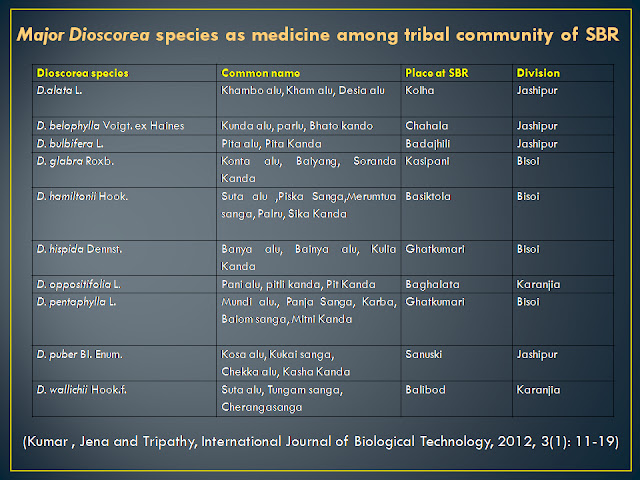
Various researchers such as Sinha and Lakra (2005), Edison et al.(2006), Mishra et al. (2007), Prusti and Behera (2007), Swarnkar and Katewa (2008), Sahu et al.(2010), Kumar et al. (2010), Namrata et al. (2011) provided ethno-botanical reports on Dioscorea species which state that it is used as a food among tribal communities of Orissa in critical time. Tubers of Dioscorea oppositifolia is used in the treatment of swellings, scorpion and snake bites, juice of Dioscorea wallichi is used in the treatment of Jaundice, Dioscorea hispida is used as an antidote in arrow poison. Dioscorea species to the food security among tribes of Jeypore tract, Orissa. Tubers of Dioscorea bulbifera are eaten after prolonged boiling in Malkangiri District of Orissa, used as contraceptive, used against cough, Leprosy, Diabetes, Spermoitic, aphrodisiac and antihelmintic and also against rheumatism (in Deogard district of Odisha), piles, dysentery, syphilis and ulcers. Dioscorea pentaphylla is used against abdominal pain after delivery.Chandra et al., 2012 reported the nutritive and phytochemicals present in Dioscorea deltoidea of Garhwal Himalaya. Several authors reported pharmacological activity of Dioscorea.among them are Ahmed et al. (2009), Rani et al. (2010), Murthy et al. (2011), Suresh et al. (2011), Suriyavathana and Indupriya (2011), Ghosh et al. (2012). They reported that Dioscorea bulbifera inhibits the α-amylase and α-glucosidase activity which is responsible for its anti-diabetic action. It has anti-oxidant, anti-hyperglycemic and anti-dyslipidemic activities. Methanol extract of Dioscorea oppositifolia has anti-ulcer activity. Ethanolic leaf extracts of Dioscorea hispida have anti-inflammatory, analgesic and anthelmintic activity. Nutritional values of Dioscorea pentaphylla, Dioscorea oppositifolia, Dioscorea tomentosa and Dioscorea spicta have been reported by Mohan and Kalidas, 2010.


Behera et al., 2010 reported the concentration of an active compound Diosgenin and ascorbic acid of the tubers of Dioscorea species found in Orissa. Mohan and Kalidas, 2010 reported the anti-nutritional compounds as Tannin, Hydrogen cyanide and Oxalate. Prakash and Hosetti, 2010 reported the anti-bacterial activity against S.aureus, P.aeruginosa and K.pneumoniae and anti-fungal against T.rubrum, M.gypseum, T.tonsurans, M.audouini and C. albicans of Dioscorea pentaphylla of mid Western Ghats. In 2005, Pérez et al. reported that Dioscorea species is used in gastritis among Yoruba Tribal groups of Cuba. Lila (2009) reported that crushed tubers of Dioscorea hamiltonii are given as body refrigerant during summer and also used in Diarrhoea, sap of tubers of Dioscorea hispida is used against Harinad( peeling of skin of feet), Dioscorea bulbifera is used against Tuberculosis, raw tuber of Dioscorea pentaphylla is used against Diphtheria in Cattle. In 2011, Danikou et al. reported that tubers of Dioscorea bulbifera are used as food plants in Bénin.Webster et al., 1984 reported the component Diobulbin D in Dioscorea bulbifera and Dioscorea hispida of Thailand which is responsible for their bitterness. Yoon et al., 2008 reported a bioactive compound Allantoin in Dioscorea rhizomes. Bhandari and Kawabata, 2005 identified bitter components as Furanoid norditerpenes cyanogens content. Martin et al., 1974 reported the yellow pigments of Dioscorea bulbifera, the major part of the yellow color is due to the presence of saponifiable easters of xanthophylls such as Lutein. Olayemi and Ajaiyeoba, 2007 reported the anti-inflammatory activity of Dioscorea esculenta. Theersin and Baker, 2009 identified phenolic compounds and analyzed the antioxidant potential of Dioscorea hispida. The Anti-clastogenic effect of aqueous extract of Dioscorea alata was reported by L. Wang et al. in 2011.
 
 
Mbiantcha et al., 2011 reported the analgesic and anti-inflammatory properties of extract from the bulbils of Dioscorea bulbiferaIn 2003, Mignouna and Dansi documented the domestication of Dioscorea species by the Nago and Fon ethnic groups in Benin. Kouakou et al., 2010 reported biochemical parameters of Dioscorea alata and Dioscorea rotundata during post harvest storage. Otegbayo et al., 2011 reported the physiochemical properties of yam Starch and effect on textural quality on food product. Marie et al., 2005 reported the anti-nutritional factors as Saponin, total phenol and tannin of selected Dioscorea species of Jamaica. Ogbuagu, 2008 reported the nutritive and anti-nutritive values of Dioscorea bulbifera and Dioscorea dumentorum. They also reported the presence of alkaloids, oxalate and saponin at high concentration are responsible for the qualification of the species as Wild (Bitter) and inedible. Polycarp et al., 2012 characterized the chemical and anti-nutritional factors as oxalates, tannin and phytates of Ghana.

Important plant diseases with special reference to Bihar and Jharkhand


Sanjeet Kumar
Ravenshaw University
sanjeet.biotech@gmail.com
 
 
Important plant diseases with special reference to Bihar and Jharkhand
 
Phytopathology is the branch of Botany which deals with the study and the understanding of the nature, development and control of plant diseases. Plant diseases sometimes spread as epidemic and destroy the crops in large area. The disease can occur in any season and at any stage of plant growth from the times of sowing of seeds to the storage of product and causes a great economic loss as well as wastage of labour. Thus the purpose of plant pathology is to provide knowledge of the cause and development of plant disease with control measure. A plant pathologist must acquire knowledge from various discipline of science to ensure enough food, fibre, medicine and fuel foe all.

Major plant diseases in Bihar and Jharkhand:
  1. Blast diseases in Rice caused by a fungus Pyricularia oryzae.
  2. Black or Stem Rust of wheat caused by Puccinia graminis tritici a heteroceous fungus.
  3. Loose Smut of Wheat caused by Ustilago trittici
  4. Leaf Blight of Maize caused by Helminthosporium turcicum
  5. Red Rot of Sugarcane caused by fungus Colletotrichum falcatum
  6. Late blight of Potato caused by Phytophthora infestans
  7. Little Leaf of Brinjal caused by phytoplasma and vector is Hishimonas phycitis a leafhopper.
  8. Ripe Fruit-Rot and Die-Back of Chillies caused by Colltotrichum capsici
  9. Leaf spot of Musturd caused by Alternaria brassicola and Alternaria brassicae.
  10. Citrus Canker caused by Xanthomonas campestris
  11. Bunchy Top of Banana caused by a virus Banana Virus-1.
  12. Leaf spot disease of mango caused by Pestalotiopsis mangiferae.
  13. Black Tip of mango caused by Brick-Kilns Smoke.
  14. Tikka disease of Groundnut caused by Cercospora archidicola

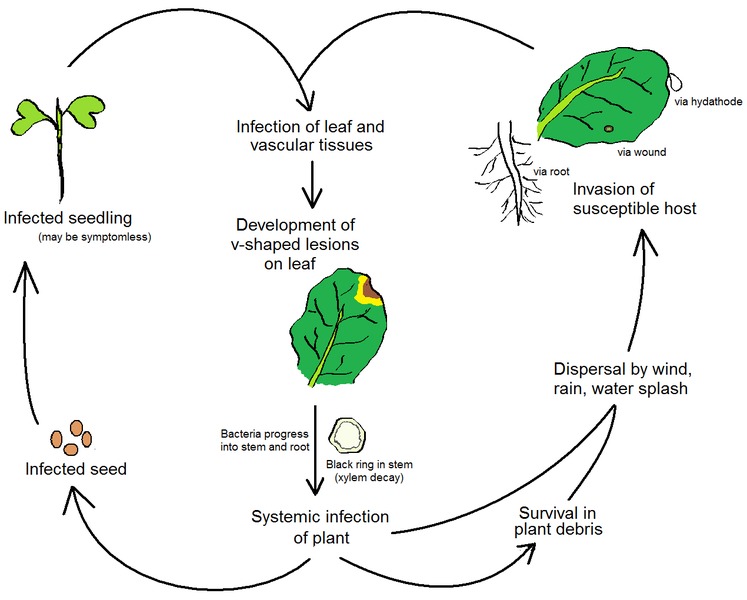
Plant pathology (also phytopathology) is the scientific study of plant diseases caused bypathogens (infectious organisms) and environmental conditions (physiological factors). Organisms that cause infectious disease include fungi, oomycetes, bacteria, viruses, viroids, virus-like organisms, phytoplasmas, protozoa, nematodes and parasitic plants. Not included are ectoparasites like insects, mites, vertebrate, or other pests that affect plant health by consumption of plant tissues. Plant pathology also involves the study of pathogen identification, disease etiology, disease cycles, economic impact, plant disease epidemiology, plant disease resistance, how plant diseases affect humans and animals, pathosystem genetics, and management of plant diseases.


Common pathogenic infection methods:
 
Cell wall-degrading enzymes: These are used to break down the plant cell wall in order to release the nutrients inside.
Toxins: These can be non-host-specific, which damage all plants, or host-specific, which cause damage only on a host plant.
Effector proteins: These can be secreted into the extracellular environment or directly into the host cell, often via the Type three secretion system. Some effectors are known to suppress host defense processes. This can include: reducing the plants internal signaling mechanisms or reduction of phytochemicals production.[1] Bacteria, fungus and oomycetes are known for this function

Some important NTFP (Non Timber Forest Product) plants of India

Sanjeet Kumar
Ravenshaw University
sanjeet.biotech@gmail.com

 
Some important NTFP (Non Timber Forest Product) plants of India

The rich biodiversity of NTFP in India not only provide income to tribal and rural people, but also provide nutritious food and play a major role to fight against Malnutrition. Quite often, besides providing timber, firewood, fodder, they serve as famine insurance in periods of food scarcity. NTFP is any commodity obtained from the forest that does not necessitate harvesting trees. It includes game animals, fur-bearers, nuts, seeds, berries,mushrooms, oils, foliage, medicinal plants, peat, fuelwood, forage, etc.  A few examples of the many different kinds of NTFPs include mushrooms, huckeberries, ferns, transplants, seed cones, piñon seed, tree nuts, moss, maple syrup, cork, cinnamon, rubber, tree oils and resins, and ginseng. Some definitions also include small animals and insects. Products are commonly grouped into categories such as floral greens, decoratives, medicinal plants, foods, flavours and fragrances, fibres, and saps and resins. Other terms synonymous with non-timber forest products include special forest products, non wood forest products, minor forest products, alternative forest products and secondary forest products. These terms are useful because they help highlight forest products that are of value to local people and communities, but have often been overlooked in the wake of forest management priorities such as timber production and animal forage. In recent decades interest has grown in using NTFP as an alternative or supplement to forest management practices such as clear-cut logging. In some forest types, and under the right political and social conditions, forests could be managed to increase NTFP diversity, and consequently increase biodiversity and potentially economic diversity. Since pre-history, humans around the world have relied on products derived from forest species for their survival and well-being. NTFP harvesting remains widespread throughout the world. People from diverse income levels, age groups, and cultural backgrounds harvest NTFPs for household subsistence, maintaining cultural and family traditions, obtaining spiritual fulfilment, maintaining physical and emotional well-being, scientific learning, and earning income. Other terms synonymous with harvesting include wildcrafting, gathering, collecting and foraging. NTFPs serve as raw materials for industries ranging from large-scale floral greens suppliers and pharmaceutical companies to micro-enterprises centred around basket-making, woodcarving, medicinal plant harvesting and processing, and a variety of other activities. Estimating the contribution of NTFPs to national or regional economies is difficult due to the lack of broad-based systems for tracking the combined value of the hundreds of products that make up the various NTFP industries. One exception to this is the maple syrup industry, which in 2002 in the United States alone yielded 1.4 million US gallons (5,300 m3) worth $38.3 million USD.


In temperate forests such as those in United States wild edible mushrooms such as matsutake, medicinal plants such as ginseng, and floral greens such as salal and sword fern are multimillion dollar industries. While these high-value species may grab the most attention, a diversity of NTFPs can be found in most forests of the world. In tropical forests, NTFPs can be an important source of income that can supplement farming or other activities. A value-analysis of Amazonian rainforest in Peru found that exploitation of NTFPs could yield higher net revenue per hectare than would timber harvest of the same area, while still conserving vital ecological services.[3] Their economic, cultural and ecological value, when considered in aggregate, makes managing for NTFPs an important component of sustainable forest management and the conservation of biological and cultural diversity.
Some major plants

1.      Aegle marmelos

2.      Aglaia elaeagnoidea

3.      Alangium savifolium

4.      Allophylus serratus

5.      Ampelocissus latifolia

6.      Annona squamosa

7.      Annona reticulate

8.      Antidesma bunius

9.      Antidesma ghaesembilla

10.  Aporusa octandra

11.  Ardisia solanacea

12.  Artocarpus heterophyllus

13.  Artocarpus lacucha

14.  Atalantia monophylla

15.  Averrhoe carambola

16.  Azima tetracantha

17.  Baccaurea ramiflora

18.  Bauhinia vahlii

19.  Borassus flabellifer

20.  Bridelia retusa

21.  Calamus gurva

22.  Calamus latifolius

23.  Citrus medica

24.  Dillenia indica

25.  Diospyros melanoxylon

26.  Garcinia cowaica

27.  Lannea coromandelica

28.  Madhuca indica

29.  Mangifera indica

30.  Manilkara hexandra

31.  Olax psittacorum

32.  Phonix sylvestris

33.  Phyllanthus emblica

34.  Psidium guajava

35.  Semicarpus anacardium

36.  Syzygium cumini

37.  Tamarindus indica

38.  Ziziphus mauritiana

39.  Ziziphus oenoplia

40.  Ziziphus rugosa

Kerang: A cultural heritage of Deomali hills

The Gadaba and Bonda tribal communities of the Deomali hills possess an age-old tradition of weaving distinctive textiles using fibres deriv...